Toilet Safety Rails for Seniors: Buying Guide
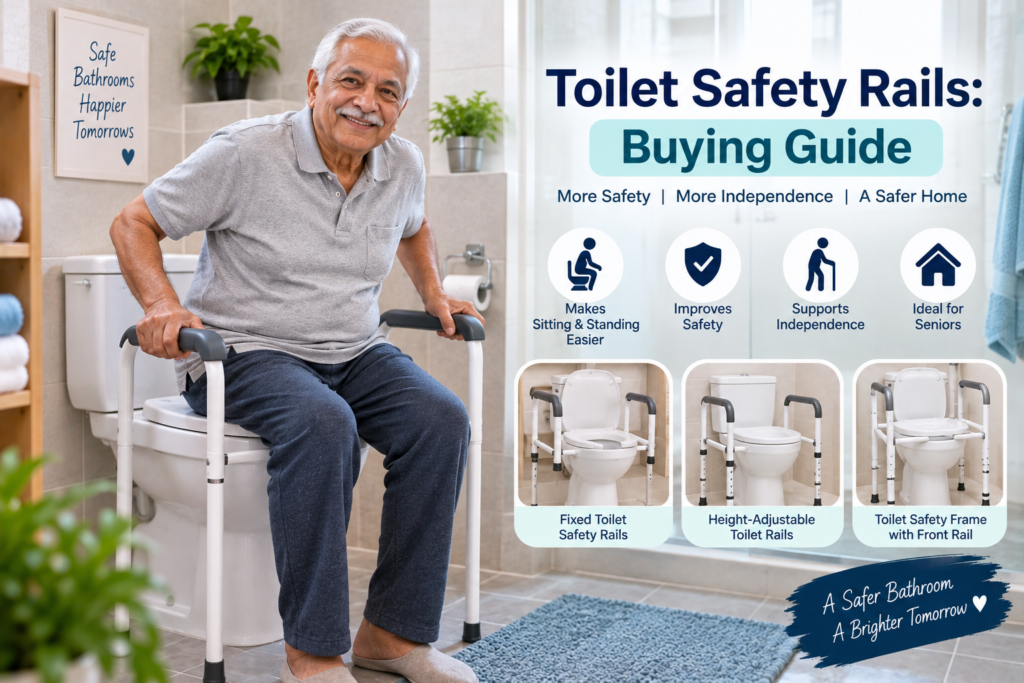
Standing up from the toilet is one of the hardest moments of the day for many seniors. A rail right beside the seat gives a firm handhold to push up from and steady yourself. This guide covers rails for the toilet area only — freestanding frames, wall-mounted rails and flip-up bars. For bars in the shower or bathtub, see our shower and bathtub grab bars guide.
What to Look for When Choosing a Toilet Safety Rail
- Rail type — a freestanding toilet frame needs no drilling and suits rented homes or walls that can’t take a fixture; wall-mounted and flip-up rails are more compact and can be fixed at the ideal height
- Placement — one rail suits someone with a stronger side; rails or frame arms on both sides give more stability
- Height and position — the handhold should sit at a comfortable push-up height beside the seat, not too far forward or back
- Stability — frames should have non-slip feet and a rigid, wobble-free build; check whether the height is adjustable
- Weight rating — confirm it suits the intended user
- Space — measure the room around the toilet so a frame or rail doesn’t crowd the door or the user
- Folding option — flip-up rails swing out of the way when not needed, useful in tight bathrooms
Featured Product: Stainless Steel Flip-Up Grab Bar (24")
A 304 stainless steel, rust-resistant flip-up grab bar with an anti-slip grip. It folds out of the way when not in use, making it a practical fit beside the toilet where space is often tight.
Freestanding Frame, Wall Rail or Flip-Up Bar?
- Freestanding toilet frame: stands around the toilet with arms on both sides. No drilling, so it suits rented homes. Check that its feet sit firmly on the tiles and that it is height-adjustable.
- Fixed wall-mounted rail: very sturdy when fixed into a solid wall. Best when the toilet is next to a wall.
- Flip-up (hinged) rail: mounted on the wall behind or beside the toilet and folds up when not needed. Useful in narrow Indian bathrooms or where a carer needs to stand beside the toilet.
- Toilet-mounted arms: bolt on using the toilet seat fixings. Compact, but less sturdy than a wall rail.
Getting the Position Right
- The rail or frame arm should be at a comfortable height for pushing up, usually a little above the height of the toilet seat.
- Place it close enough to reach without leaning forward, but not so close that it gets in the way of sitting down.
- If your parent has a stronger side, place a single rail on that side.
- For people who need more support, rails or frame arms on both sides give better balance.
A physiotherapist or occupational therapist can suggest the best position after watching your parent sit and stand. Our guide on where to install grab bars also has placement tips.
Installation and Safety
- Wall rails must be fixed into solid brick or concrete with suitable anchors. Hollow walls, tiles alone and weak plaster may not hold the weight.
- In many Indian bathrooms, pipes run inside the wall, so check for them before drilling.
- Pull firmly on the rail after installation to test it, and check the screws every few months.
- Never use a towel rail, soap holder or tap as a support. These are not designed to hold a person’s weight.
Related Guides
Frequently Asked Questions
Do I need a rail on both sides of the toilet?
Not always. One rail on the stronger side is enough for many people. If balance is poor or both sides are weak, a frame or rails on both sides are safer.
Can I install a toilet rail in a rented flat?
A freestanding toilet frame needs no drilling, so it is usually the easiest option in a rented home.
Is a flip-up rail as strong as a fixed rail?
A good-quality flip-up rail fixed properly into a solid wall is strong enough for most people. Always check the stated weight rating and have it fitted securely.
How do I clean around a toilet frame?
Most frames can be lifted away for cleaning the floor. Wipe the frame regularly with a mild disinfectant, and check the rubber feet stay in good condition.
Before You Buy
Decide first whether a freestanding frame or a fixed rail suits your bathroom. For wall-mounted or flip-up rails, check the wall type and strength before buying mounting hardware, and consider a professional fitting so the rail stays securely anchored for daily use.