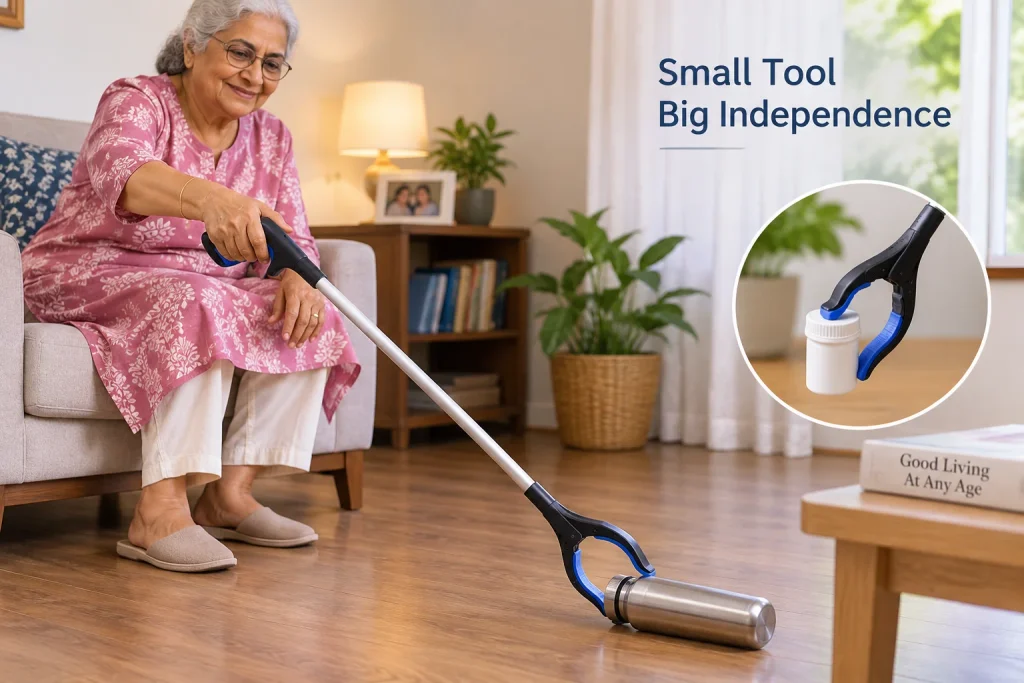
A reacher (grabber tool) is one of the simplest daily living aids, but it directly addresses a real fall-risk moment: bending, stretching, or climbing to reach something dropped or stored high up.
Why It Matters More Than It Seems
Reaching for a dropped item or something on a high shelf often involves exactly the kind of off-balance movement — twisting, overreaching, standing on a low stool — that leads to falls. A reacher removes the need for that movement in a large share of everyday situations.
What to Look For
- Length: Around 60–80 cm suits most household use, long enough for shelves and the floor without being unwieldy to store or carry.
- Grip mechanism: A trigger-style handle that’s easy to squeeze, without needing significant hand strength, matters for anyone with arthritis.
- Jaw grip: A rotating or rubberised gripping end handles a range of object shapes and sizes more reliably than a simple pincer.
- Weight: A lightweight reacher is easier to use for repeated reaches without tiring the arm.
Common Uses Around the Home
Picking up dropped items from the floor, retrieving things from high shelves or the back of a cupboard, and reaching items from a seated position without needing to stand at all are the situations where a reacher earns its place quickly.
Helpful Products on Amazon
Grabber Reacher Tool for Elderly & Seniors
Approx. ₹599 (price as of writing — check Amazon for current price)
View on Amazon →As an Amazon Associate, we earn from qualifying purchases. See our affiliate disclosure.
How to Use a Reacher Safely
- Use it within arm’s length plus the reacher, with no stretching on tiptoe or leaning far forward.
- Avoid lifting heavy items such as full bottles, pans or bags. Reachers are designed for light objects.
- For items on high shelves, slide them to the edge first, then lower them gently.
- When picking up from the floor while seated, keep your back supported and feet flat on the ground.
- Keep the reacher in a fixed, easy-to-reach place, such as beside the bed or chair, so it is always to hand.
Where a Reacher Helps Most in Indian Homes
- Picking up items that fall under the bed or behind furniture
- Reaching clothes hung on a high line or in a tall almirah
- Retrieving utensils from high kitchen shelves or lofts
- Pulling a light blanket or clothing closer without standing up
- Helping with dressing, such as pulling up trousers or positioning a sock aid
Signs It Is Time for a Reacher
Watch for your parent climbing on a stool or chair to reach things, holding on to furniture while bending down, or asking others to pick up small items. These are early signs that a reacher, and possibly other daily living aids, would help keep them safe and independent.
Related Guides
- Useful Daily Living Aids for Elderly Parents
- Dressing Aids for Seniors With Limited Mobility
- Easy-to-Use Kitchen Aids for Seniors
- How to Prevent Falls at Home for Elderly Parents
Frequently Asked Questions
Is one reacher enough for the whole house?
Many households find it useful to keep one in a frequently used area (like near a favourite chair) and a second in the kitchen or bedroom, rather than carrying one around.
Can a reacher replace a step stool entirely?
For most everyday high-shelf items, yes — which is useful, since climbing on a stool is itself a meaningful fall risk for an older adult.